
In English
Union members approve work-based immigration
Members of the Industrial Union welcome foreign colleagues, as long as their terms of employment follow Finnish standards and regulations. So say almost nine out of ten in the union members’ panel.
In September 2025, the union commissioned an open members’ panel survey for all members in working life. A total of 3,877 people joined up to share their opinions.
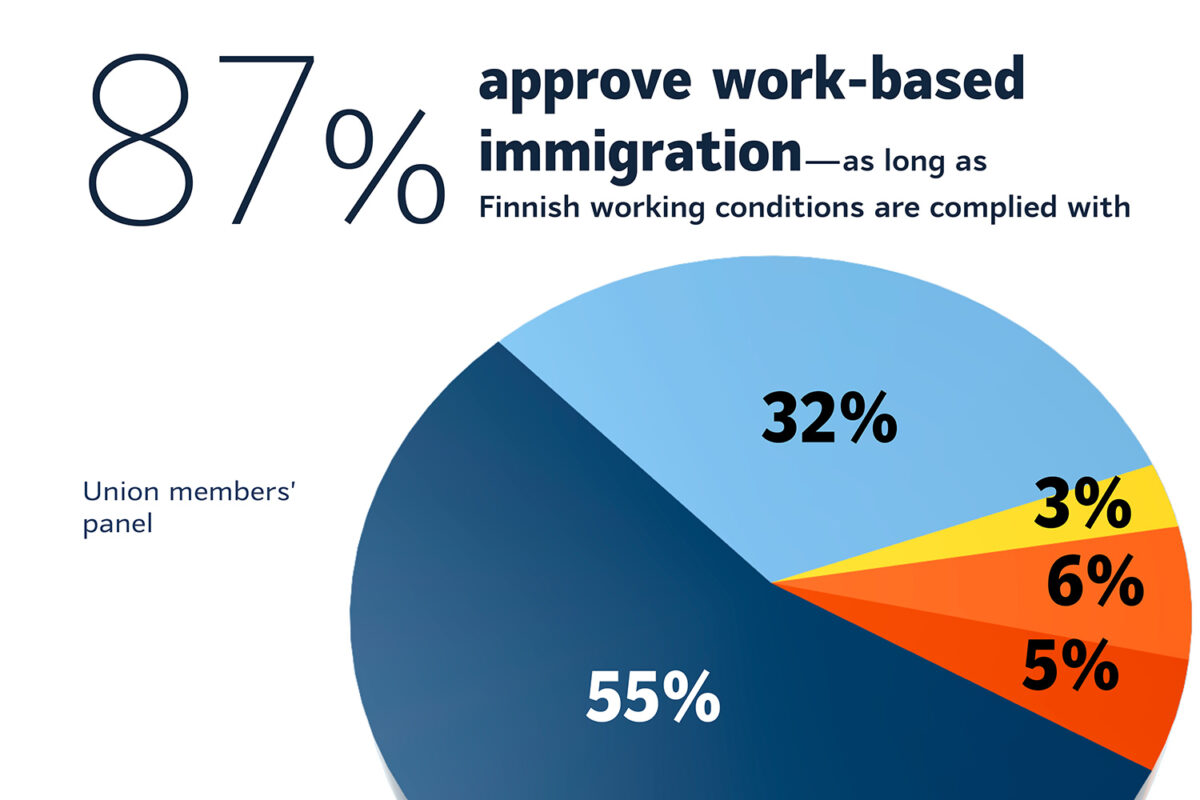
”Work-based immigration is acceptable as long as Finnish working conditions are complied with”, is one of the statements the panel members were asked to evaluate. 87 per cent agreed or strongly agreed with the statement. Only five per cent strongly disagreed, and six per cent disagreed.
– Members accept workmates who come from abroad. However, union members have placed some conditions on this, says Timo Nevaranta, the Head of Public Affairs at the union.
– The main proviso is that Finnish terms of employment must be followed. If this is relaxed, the acceptability of this phenomenon will decline.
”Employers must be held more accountable for violating the terms of employment of foreign workers”, was another statement for panelists to comment on. With this statement, 86 per cent agreed or strongly agreed. Only eight per cent either disagreed or strongly disagreed.
The Industrial Union demands legislation to curb workplace exploitation and the grey economy. In addition, more resources are needed to enforce the laws. A key demand is the criminalisation of wage theft. Currently, failure to pay wages in accordance with the law and collective agreements is not punishable under criminal law.
Nevaranta gives an example: someone who steals a lollipop worth 20 cents will get a fine. However, an employer who fails to pay hundreds or thousands of euros in wages will not face any penalties, they will just be made to pay the unpaid wages.
– In Finland, it is easy for companies to get away with things. You have to be very unlucky to be held accountable.
– Lawmakers and political parties need to wake up and give this issue the attention it deserves. The time for tinkering is over, Nevaranta says.
No to unfair advantages
Trampling on the terms of employment of one group of employees threatens the working conditions of all employees.
Dishonest companies gain a competitive advantage by having work done in violation of laws and collective agreements.
– It is not the Ukrainians’ fault if they are paid in daily allowances. It is the employer’s responsibility, says Nevaranta.
Nevaranta wonders why employer organisations are not more enthusiastic about combatting the grey economy and defending their honest member companies. This should not be something that only employees demand. There should be a united front.
The responses to the member panel survey also show that members are concerned about how work-based immigration will affect working conditions and unemployment.
– Both of these are concerns that should be taken seriously. That is why it is important to adhere to the availability assessment, says Nevaranta.
The availability assessment aims to prevent the import of labour into sectors where there is unemployment. The starting point is that companies must hire employees from Finland or the EU and EEA. If labour cannot be found there, it is possible to hire from further afield.